Well today i will dig through ALL my hives and make splits where i can and the hives can aford the brood and bees. i have a few hives in mind for this, 9 in particular. I dont really expect to be able to make 9 splits, but we will see. I have a bunch of drawn comb and stored capped honey so maybe bewteen the two things will work out.
My biggest concern is not temps etc, but that i have 10 Russian Queens coming the week of April 11th, exactly one full brood cycle. So i am praying that i wont wind up with a bunch of hives that i pulled splits from that dont have enough brood and or bees to make 10 more splits when the queens arrive!!! I am hoping with good weather and drawn comb the queen will go right back to laying in the comb and by April 11 week comes around i will have the same number of eggs/brood frames as i do today...
We shall see.
Friday, March 18, 2011


Wednesday, March 2, 2011
Failing Queen or Hygenic Behavior????
This is a post written by Randy Oliver on Bee-L which really sums up how to identify if your "spotty" brood pattern is from a failing queen, disease, virus, or expression of hygienic behavior (which is good). I believe it is important enough to post for documentation and to share...
---------- Forwarded message ----------
From: randy oliver <randy@randyoliver.com>
Date: Wednesday, March 2, 2011
Subject: [BEE-L] Intermittant brood pattern
>
> > How does one tell the difference between a failing queen and brood
> > that
> has been removed due to hygienic behavior.
Mike, there are other possible reasons for the shot pattern:
Miticide or pesticide contamination of comb Virus mortality Fast-acting AFB strain
All above, plus failing queen, could be ruled out by inserting a drawn comb in the center of the brood nest. The queen should start laying immediately.
Then simply follow that brood up to capping, and a few more days. Hygienic uncapping won't happen until later.
If queen is failing, then you will see a poor egg pattern. If larvae or eggs are removed shortly after queen lays them, then suspect nutritional stress.
If the egg and larval development pattern is uniform, and the larvae uniformly develop through capping, then you can rule out the above. Removal after that would likely be due either to hygienic behavior or virus mortality. If hygienic, the removed pupae will be white and solid during removal. If virus, they will be miscolored (gray) or disfigured.
Hope this helps!
Randy
***********************************************
The BEE-L mailing list is powered by L-Soft's renowned
LISTSERV(R) list management software. For more information, go to:
Guidelines for posting to BEE-L can be found at:
http://honeybeeworld.com/bee-l/guidelines.htm
Here is a picture of a solid brood pattern (top) and a spotty brood pattern (bottom) i found at University Of Ga's site http://www.ent.uga.edu/bees/disorders/non-infectious-diseases-pests.html

Here is a picture of a solid brood pattern (top) and a spotty brood pattern (bottom) i found at University Of Ga's site http://www.ent.uga.edu/bees/disorders/non-infectious-diseases-pests.html

Tuesday, March 1, 2011
My Little Farmer Girls
These are two pictures of my 2 yr old twins walking across what was my watermelon patch and now is back in pasture seed for our Alpacas and soon a Angus Steer for beef...


Monday, February 28, 2011
Capped Drone Cells???
Capped Drone Cells???
So this past Sunday I completed my inspections on my last three hives. They are loaded with bees and brood, I have come to be a believer of annual queen replacements especially for your so-so hives, obviously I would keep my proven breeders. Anyway, in these three hives I saw tons of brood, but what surprised me was the amount of capped drone brood! Technically I could start grafting although I am going to hold off for a few more weeks for more certainty on warmer weather. So keep your eyes open for upcoming swarm cells. I have a feeling with this warm weather, unusual long flying days, tons of pollen, etc coming in swarm season will be early this year especially if the weather continues like it has been!!!
I also wanted to mention that I combined two hives this weekend, one with tons of resources (bees) but queenless and the other with a laying queen but low on resources (bees) so she couldn’t lay anymore than what she was doing, a queen will only lay eggs up to what her workers can tend to. So I decided to combine the two hives using two sheets of newspaper. I will keep my fingers crossed. With the increased number of bees the queen should be able to ramp up and hopefully catch with the others because she is a long ways behind.
All other strong hives received entire deep boxes of drawn comb to help any swarming instinct they might have. I was going to Checkerboard but I was a week late it seems since they all had brood in the top and bottom boxes so checker boarding them would have broken the brood nest up risking chilling brood. So I figured having that dark empty brood comb above them might entice them to continue to expand the brood nest and not contract it and swarm… we shall see it worked last year.
So in the end I have 14 out of 18 living (3 dead-outs and combined 2 to make 1, so I count that as a single loss since I caught it, but would have led I am certain to both hives being lost, Chalk one up to actually inspecting the hives!!!!)

Thursday, February 24, 2011
Bees and Bluegrass???
I often wonder why my bees are so happy, i just figured it out. Its because usually when i am inspecting my hives my truck is on Bluegrass Junction on my XM Radio...
Incase you dont know what Good Bluegrass sounds like check out these links
http://www.youtube.com/watch?v=3XV7mxfIIr0&NR=1
http://www.youtube.com/watch?v=e3IrnNAweM0
and check out:
Larry Sparks (my favorite) http://www.youtube.com/watch?v=XJpkMNbGvC0
Blue Moon Rising
Dale Ann Bradley
SteelDrivers
and plenty more i can't think of right now...
Tuesday, February 22, 2011
VSH Behavior (Uncapping Pupa and Recapping to remove mites)
VSH bahvior will and can be a whole slew of traits but one most noticed is the removal of deseased larva/pupa. In the case of pupa the bees smell the reproductive pheromone of the adult varroa mite and uncap the pupa (youl see pupa eyed pupa). In some cases the heads will be chewed a bit of the bee pupa and in other cases perfectly fine in which case they will re-cap the cell.
See the attached picture from one of my hives this past year... can you find the partially capped cell i didnt highlight?

See the attached picture from one of my hives this past year... can you find the partially capped cell i didnt highlight?

Monday, February 21, 2011
First Spring Inspections
Well we had 75 deg temps on Friday so I took the day off and did a few things which included inspection 15 out of my 18 hives in Buckingham. Out of the 15 I had 3 dead outs. Upon a postmortem, all 3 died from high level of Varroa mites.
At the recent Va State Beekeeping Fall Meeting Randy Oliver talked a bit about postmortem inspections and varroa mites. One tip he gave was to hold the frame by the bottom bar and with the sun at your back look at the top of the cells for little whitish specks of varroa mite poop. Now you have to be careful you’re not looking at wax bit from robbing but I could plainly see the poop across the brood frames!!
All 3 dead outs have been “flying” excellent and I had zero worries (it was the robbers flying in and out, so don’t tell me you can tell a healthy hive from a weak or dead one by looking at the front…), however I noticed two things upon popping the tops on the dead outs right off. When I smoked the top bars the hive “exploded out” (which were the robbers leaving) and that most of the honey was uncapped looking from the top down… At times you would the living hives with foragers with pollen coming in, so this is a clue from the front, but in some cases great hives did not have a forager with pollen for multiple minutes coming in, so without spending many minutes in front of each hive, do a quick inspection…
Anyway, I have 2 hives I am uncertain about. One I couldn’t find the queen or eggs but was bringing in pollen like crazy and had tons of bees… and the other I found the queen, a cantaloupe sized amount of bees, and a small batch of eggs, so I am a little concerned about this one, especially if we get a hard cold snap…
I had some hives that had just started to lay and others that had literally frames of capped brood (one I could take to almond pollination due to its strength…LOL)
All my nucs are thriving and will explode soon! So I have great proof that this is the way to go overwinter since they are stronger than my full size hives.
I have my dead out equipment (since I could confirm varroa mites killed them) sitting on a little trailer so the wax moths wont damage them but the bees can finish robbing the capped honey out as food, stimulation, and so I will be able to use some for honey supers for me.
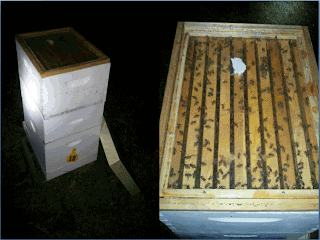
The pictures below show some capped brood, healthy bees, dead out comb with cappings torn up, a close up of cappings torn up due to robbing, and my dead out boxes loaded up (4 deeps and 3 mediums)...

Pictures of Varroa Poop Holding the bottom bar towards you and sun at your back looking at the top of the cell wall...

Subscribe to:
Posts (Atom)